Ecommerce teams have access to more customer evidence than ever.
Analytics can show where performance changes. Research can tell us where customers struggle. Session recordings show what people actually do. Experimentation tells us what happens when we change the experience. Personalization results can show that the same experience does not work equally well for everyone.
And somehow, teams can still sit in a meeting surrounded by all of it and ask:
So what should we actually do?
I do not think that is usually a data problem.
I think it is a decision problem.
The challenge with ecommerce data-driven decision making is not just collecting more information. It is connecting what you already know well enough to understand what deserves attention, what the customer may actually need, and what kind of response makes sense.
That sounds obvious, but it gets complicated quickly because most companies do not look at the customer journey as one connected system.
The Customer Does Not Experience Your Org Chart
Most ecommerce organizations divide the experience into disciplines.
UX looks for usability issues and journey friction. CRO looks for conversion opportunities. Experimentation teams look for hypotheses worth testing. Personalization teams look for audiences that might benefit from a different experience. Merchandising thinks about assortment and product placement. Analytics focuses on what the numbers are doing.
Those perspectives are all useful, but they also shape how problems get interpreted.
If a conversion issue lands with a CRO team, the conversation can quickly become about what to test. If it lands with UX, the focus may shift toward usability. A personalization team may start thinking about which audience should get a different experience. Merchandising may see the same behavior and conclude that product ordering or assortment is the problem.
None of those interpretations are necessarily wrong.
The problem is that the discipline can start determining the solution before the customer problem is fully understood.
The customer does not experience research, CRO, personalization, merchandising and analytics separately. They experience one journey. They are trying to find something, compare options, understand differences, build confidence and eventually make a decision.
The lines between our internal teams mean nothing to them.
The customer does not experience your org chart. They experience one journey.
That is why I think the starting point needs to move upstream.
Before asking what we should test, personalize or redesign, we need to understand what customers appear to be trying to do and where the current experience is making that harder.
Starting With the Tactic Changes the Question
The way we frame the problem matters because it changes the questions we ask.
If the goal is to build an experimentation roadmap, the natural question becomes, “What should we test?” If the goal is to expand personalization, the question becomes, “What audiences can we create experiences for?” If a redesign is already planned, the team starts asking what should change on the page.
Those are reasonable questions, but they are already solution-shaped. They assume that the answer belongs inside a particular discipline.
A better starting point is to ask what the evidence tells us about customer behavior and what that behavior suggests the experience needs to do better.
That creates more room for the right answer.
Sometimes the evidence points to an experiment because the opportunity appears meaningful but the outcome is uncertain. Sometimes it points to personalization because different types of visitors clearly need different things from the experience. Sometimes something is simply creating unnecessary friction and should be fixed without turning it into a six-week test.
And sometimes the evidence is not strong enough to justify changing anything yet. The most useful next step may be better measurement, additional research or simply watching the behavior more closely.
That last possibility matters because optimization programs can create pressure to keep producing activity. More tests, more experiences, more segments and more changes can make a program look busy.
But activity is not the same thing as making a better decision.
Better Ecommerce Decisions Start With Customer Behavior
The framework I use to organize this thinking is simple:
Evidence → Behavior → Intent → Friction → Opportunity → Action
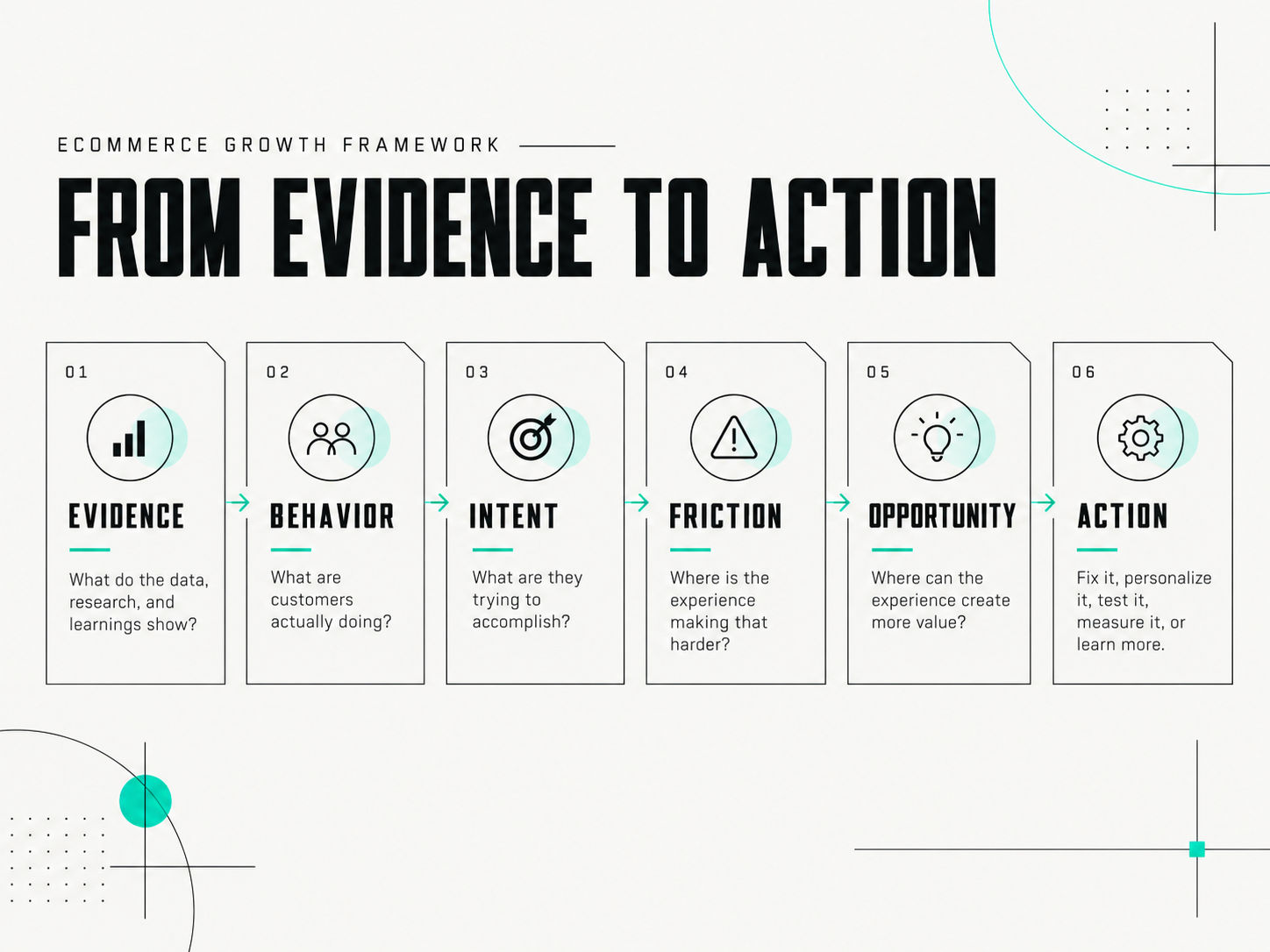
What is ecommerce data-driven decision making? It is the process of using customer behavior, analytics, research, experimentation and other evidence to decide which ecommerce problems deserve attention and what action is most appropriate.
The point is not to create another methodology for its own sake. It is to keep the tactic from becoming the diagnosis.
You start with the evidence that already exists. That might include analytics, customer research, survey feedback, search behavior, session recordings, experiment results, personalization performance or customer support themes.
The first job is to understand what those sources are actually showing instead of immediately jumping to what should change.
From there, the question becomes behavioral.
What are customers actually doing?
A drop in conversion tells you that performance changed, but it does not tell you why. A visitor moving repeatedly between a category page and several product pages could be struggling, or they could simply be comparing options. Someone repeatedly returning to the same product may be confused, or they may be close to buying and looking for one final piece of reassurance.
Those distinctions matter because the same metric can represent very different customer needs.
This is where intent becomes useful.
You may know very little about who a visitor is, but their behavior can still tell you quite a bit about what they appear to be trying to accomplish right now. Someone early in product discovery may need help narrowing a large assortment. Someone comparing several similar products may need clearer differentiation. Someone who has returned multiple times may need confidence rather than more choice.
Once you understand the likely intent, friction becomes easier to identify.
The question is no longer simply whether something on the page is “good” or “bad.” It becomes whether the experience is supporting the decision the customer is trying to make.
Maybe there are too many options. Maybe an important piece of information is buried. Maybe the site keeps introducing new choices when the visitor is actually trying to narrow them. Maybe a promotion interrupts someone who was already ready to buy. Maybe content that helps an early-stage visitor becomes noise for someone much further along.
That is the point where a useful opportunity starts to emerge.
Only then should the team decide what kind of action makes sense.
The tactic should not determine the diagnosis.
Fewer, Better Opportunities
One of the things I have always struggled with in traditional CRO work is the giant audit.
It is not difficult to review an ecommerce site and find dozens of things that could theoretically be improved. You can recommend moving elements, changing calls to action, adding social proof, simplifying navigation, introducing urgency, making something sticky or personalizing a hero.
The final document can look impressive because it contains a lot of recommendations.
The harder question is whether any of those things actually deserve to be done.
A long backlog often creates the illusion of clarity while pushing the real decision back onto the team. They still have to figure out which ideas matter, what evidence supports them and why one opportunity should take priority over another.
I would rather leave a team with five strong opportunities than forty loosely supported recommendations.
A useful opportunity has a clear chain behind it. The evidence shows a pattern. That pattern tells us something about customer behavior. The behavior gives us a reasonable view of what the customer may be trying to accomplish. The current experience creates friction around that need. That friction creates an opportunity, and the evidence helps determine the most appropriate action.
The recommendation might ultimately be simple. The value is not in making it complicated. The value is in being able to explain why that action is worth taking.
That also makes the work easier to challenge in a productive way. A team can disagree with the interpretation, question the strength of the evidence or suggest a different action. At least the conversation is grounded in something more useful than “best practice says we should do this.”
Better Optimization Starts With Better Decisions
CRO, UX, experimentation and personalization all matter. I work across all of them, and I have seen each one create significant value.
But I do not think any of them should be the starting point.
The starting point should be the customer behavior and the business problem you are trying to understand.
When we begin with the tactic, we tend to find problems that fit the tool we already know how to use. When we begin with the evidence, we give ourselves a better chance of finding the actual problem.
That changes the quality of the questions.
- Instead of asking what we should test, ask what uncertainty actually needs to be resolved.
- Instead of asking who we can personalize for, ask whether anyone genuinely needs a different experience.
- Instead of asking what we should add to the page, ask what is making the customer’s decision harder than it needs to be.
Those questions do not always produce more work.
They usually produce better work.
And that is the point.
Have Plenty of Customer Evidence but Still Not Sure What Deserves Attention Next?
The Ecommerce Growth Opportunity Sprint is designed for teams that already have analytics, research, experiment results, customer feedback or other evidence but need a clearer view of what matters most.
I bring those inputs together to identify the 5–10 growth opportunities most worth acting on, why they matter, and the most appropriate next step.
No generic CRO checklist. No predetermined tactic.
Learn more about the Ecommerce Growth Opportunity Sprint →
This same approach shapes how I think about ecommerce growth consulting across UX, CRO, experimentation and personalization.