Jensen Huang, CEO of NVIDIA, described AI data centers as “factories”, systems that take in energy and output intelligence. That framing doesn’t just apply to AI.
It’s exactly how smart brands should think about Conversion Rate Optimization (CRO).
Because the truth is: most companies don’t have a CRO strategy—they have a CRO wishlist. A backlog of ideas, a few tests per quarter, and a design team stretched thin. That’s not optimization. That’s gambling.
The brands seeing consistent gains treat CRO like a factory: inputs go in, value comes out—predictably, systematically, and at scale.

What Is a CRO Factory?
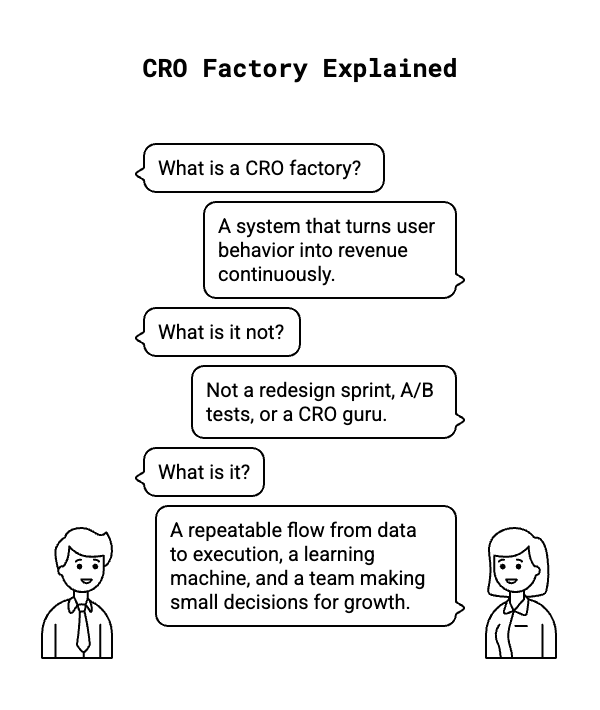
A CRO factory is a system built to turn user behavior into revenue. It doesn’t wait for ideas. It runs continuously.
It’s not:
- A quarterly redesign sprint
- A few A/B tests bolted onto a campaign
- A CRO “guru” chasing one-hit wonders
It is:
- A repeatable flow from data → insight → hypothesis → execution
- A machine for learning what works and compounding those wins
- A team or system that makes dozens of small decisions that add up to real growth
The Inputs That Keep It Running
Factories don’t operate on vibes. They need materials to process. In CRO, those inputs are:
- Visitor behavior patterns: click paths, bounce points, scroll depth, exits
- Intent signals: search terms, entry pages, cart activity
- Segment performance: where different audiences succeed or struggle
- Prior experiment learnings: what’s already been tried—and what worked
If you’re not feeding your program these raw materials, you’re not optimizing. You’re guessing.
Where Most Factories Break Down
Even brands that want to optimize often stall. Why?
- No prioritization engine – Every idea feels “important,” so nothing gets done.
- No delivery cadence – Teams start strong, then slow to a crawl.
- No insight feedback loop – Wins aren’t documented or reused. Learnings die in decks.
A real CRO factory fixes this. It runs on clarity, consistency, and conversion momentum.
Why This Matters Now More Than Ever
AI is changing customer expectations faster than any previous tech shift. People don’t want to browse—they want answers. Don’t want to filter—they want relevance. Don’t want to wait—they want instant clarity.
If your site is still making changes quarterly and your test results live in PowerPoint, you’re not just behind. You’re leaving compound gains on the table every day.
A CRO factory closes that gap. It lets you:
- Respond faster to behavior shifts
- Test more ideas without chaos
- Turn insights into ongoing value
- Deliver incremental revenue with structure—not stress
What a Healthy CRO Factory Looks Like
You don’t need a massive team. You need a working system.
- Inputs: Data, ideas, behavior patterns
- People: A strategist, an analyst, and someone who can ship
- Cadence: Weekly or bi-weekly test launches, documented rigorously
- Outputs: Wins, learnings, segment-specific insights, personalization candidates
Think of it like a flywheel. Every turn makes the next one easier—and more valuable.
So… Do You Have a CRO Factory?
If you’ve got traffic, tools, and a list of ideas, you’re halfway there.
What most teams are missing is the system to put those pieces to work reliably. The infrastructure to turn intention into impact.
So here’s the real question:
Are you set up to learn faster than your competitors? Or are you hoping for a lucky break?
Let’s Build Your Factory
If you’re not sure where your factory is breaking down—or if you’ve even built one yet—let’s take a look together.
You might be closer than you think.
Ready to Fuel Your CRO Factory?
Reducing Friction: The Most Overlooked Way to Improve Conversions
Friction slows the line. Learn how to identify and eliminate invisible blockers that jam up your optimization system.
Your Segments Aren’t the Strategy. Your Actions Are.
A factory without execution is just a blueprint. See how turning segment insights into action keeps your CRO flywheel spinning.