Your home page is the most overvalued page on your site and often the least important page in the actual customer journey.
Recently, I posted a simple statement on LinkedIn:
“Your home page is the least important page on your site.”
The post reached hundreds of thousands of people and sparked more comments than anything I have written. Some loved it. Some pushed back. Many admitted they had been feeling this tension for a long time.
I understand why the post hit a nerve. The home page has always been treated like sacred ground. It is the page internal teams obsess over, debate over, redesign over, and present to leadership as the centerpiece of their digital experience.
There is only one problem.
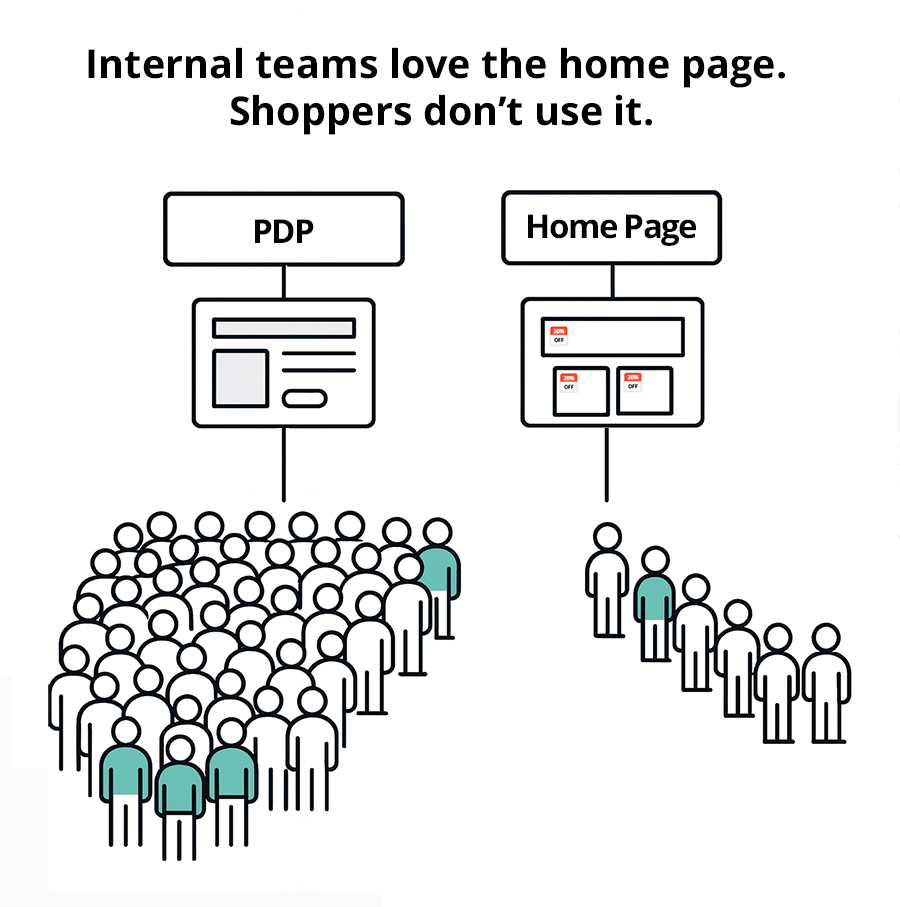
Most visitors never start there.
And that disconnect creates a massive amount of wasted effort inside organizations.
This article breaks down the conversation that unfolded, the misunderstandings, the supportive comments, the pushback, and the larger point the debate revealed. It also explains how this ties into a more modern approach to ecommerce built around visitor intent, experimentation, and personalization.

Why the Home Page Is Overvalued Inside Companies
One of the clearest themes in the comments was how common these internal debates are. People described the same dynamic inside their own companies: endless arguments about tiles, banners, and hero images that end up consuming weeks of attention.
Meanwhile, the actual customer journey is happening elsewhere.
Why does this happen?
Internal visibility creates a false sense of importance
Everyone inside the company sees the home page every day. It is used in reviews, meetings, and design discussions, so it naturally feels important.
But internal visibility does not equal customer value.
The home page becomes a political battleground
When ten teams want space, the home page becomes a negotiation table. It turns into a competition for visibility rather than a page designed to help visitors move forward.
A comment summed it up well:
“Internal teams will spend months arguing about banners that nobody sees.”
It feels safer to change the home page than the pages that actually matter
Optimizing PDPs, PLPs, cart, and checkout requires clear hypotheses and accountability. Changes are measured. Results matter.
The home page feels subjective. It becomes the place teams “play” with creative or messaging because the stakes feel lower, even though the impact is also lower.
The outcome is predictable. Too much energy goes into a page that drives far less revenue than people assume.
All of these internal dynamics explain why the home page is overvalued compared to the pages that actually influence decisions and revenue.
What Actually Happens: Visitors Start in the Middle of the Site
Across comments and my own experience, the same pattern emerges.
Visitors enter through:
- Product pages
- Category pages
- Search results
- Gift guides
- Ad landing pages
- Email links
- Social links
- Content hubs
The home page is often:
- A secondary navigation hub
- A recovery page when visitors need to reorient
- A returning visitor touchpoint
- A page people choose to visit, not one they land on
In short, the home page does matter. It just does not play the role many teams assume it does.
One of the comments captured the idea well:
“Revenue happens where people actually land.”
According to the 2025 Contentsquare Digital Experience Benchmark Report cited in the article: PDPs are now the most popular landing page and their share is up year-over-year.
The Homepage is Dead: Rethinking PDP Strategy for Revenue Growth
The Misunderstood and Negative Comments (And What They Reveal)
Some pushback showed up frequently. These arguments are worth addressing because they reveal how teams think about their sites.
Comment: “The home page sets the vibe.”
It can contribute, but only for visitors who land on it.
Most visitors form their impression on PDPs, PLPs, or specific landing pages tied to marketing.
A brand that depends on the home page to set the tone is designing around internal preference, not visitor behavior.
Comment: “The home page is the front door.”
It used to be. It is not anymore.
Today’s “front door” shifts constantly based on where the visitor comes from.
Comment: “Are you saying the home page should disappear?”
No. The point is not that the home page should be removed. The point is that its strategic value is inflated compared to the pages that actually drive outcomes.
Think of the home page as supporting the journey, not defining it.
Comment: “The home page is our biggest brand moment.”
Brand moments happen everywhere.
A clean PDP is a brand moment. A curated PLP is a brand moment. A personalized prompt is a brand moment. A clear navigation path is a brand moment.
If the home page carries all the brand weight, the rest of the journey is not doing enough.
The Positive Comments That Reinforced the Core Insight
Some of the strongest comments came from people who recognized the same internal behaviors across industries. These reactions supported the key point of the original post:
The home page receives far more internal attention than its actual impact deserves.
Comments included:
- “Start with the internal pages. That’s where customers actually shop.”
- “Teams fight about banners no one notices.”
- “The home page gets overbuilt while the PDP gets ignored.”
The consistency across these comments makes it clear that the home page is overvalued across most organizations, regardless of size or industry. It is organizational. Many companies follow the same pattern without noticing how much it slows them down.
Where Effort Should Actually Go
If a brand does not have experimentation or personalization
Your home page should not be your first priority.
Start with:
- Product discovery
- PLP and PDP clarity
- Add-to-cart friction
- Checkout flow
- Intent pathways (for gift shoppers, new visitors, returning visitors)
These produce measurable gains far more quickly.
If a brand has a mature experimentation and personalization program
Intent becomes your north star.
At this stage:
- A simple home page is an asset
- Personalization can carry relevance
- Content can change based on behavior or past browsing
- The home page can serve as a flexible canvas instead of a static billboard
This is where the home page becomes useful again, but with a very different purpose.
Across all maturity levels, the principle stays consistent:
Do not overvalue the home page.
Support the visitor’s intent.
Design around behavior, not assumptions.
How This Fits Into a Modern Ecommerce Philosophy
My entire approach comes down to one idea:
Understand what the visitor is trying to do and help them move forward.
This shifts everything:
- You stop designing based on internal debates.
- You stop assuming the home page is the center of the experience.
- You focus on intent and relevance.
- You simplify before you personalize.
- You prioritize changes based on actual visitor behavior.
The home page debate is really a symptom of something deeper.
Many organizations still design around what they want to show rather than what visitors need to see.
Once this flips, growth accelerates.
What a Home Page Should Do in 2025 and Beyond
A modern home page should:
- Provide simple, stable navigation
- Highlight key categories
- Reinforce core brand messages
- Surface relevant items for returning visitors
- Offer clear pathways for different shopping missions
- Stay clean
- Stay lightweight
- Support personalization
A home page should not:
- Be overloaded with competing priorities
- Become the default canvas for every new idea
- Carry the entire weight of brand storytelling
- Try to speak to every visitor at once
In most cases, the home page should be a support page, not a centerpiece.
The Real Takeaway
The point of the original post was never that the home page does not matter.
The point was that its importance is inflated inside organizations compared to its actual role in the customer journey.
The home page still serves a purpose. It just should not dominate your attention. Real impact comes from improving the pages where visitors land, decide, compare, hesitate, and buy.
If there is one idea to take away, it is this:
The most important page is the one your visitor is standing on right now.
Design for that reality, and everything improves.
Further Reading
Adaptive PDP Strategy: Why Every Product Page Has Two Jobs
When Removing Promotions Increases Revenue
Retailer Intent vs Shopper Intent: The Personalization Gap