Personalization is supposed to make things easier for shoppers. But too often, it becomes a battle of retailer vs shopper intent—where the experience serves the brand more than the customer.
This retailer vs shopper intent disconnect is one of the biggest reasons personalization underperforms — and why so many eCommerce journeys still feel frustrating, even when they’re “optimized.”
Here’s the core difference:
- Retailer’s Intent: Boost sales, increase average order value (AOV), and promote more items to increase cart size.
- Shopper’s Intent: Find specific products that match their needs, budget, and preferences — quickly, easily, and without distractions.
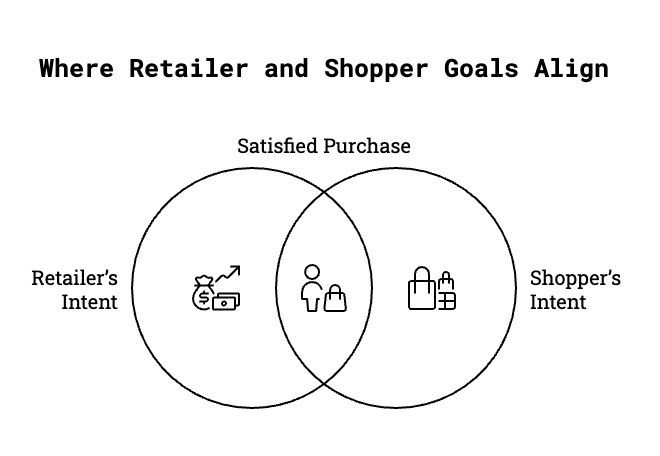
When these two intents don’t align, you don’t just lose sales. You lose trust.
Retailer Goals: Bigger Carts, Not Better Journeys
It’s easy to see why retailers think this way. The KPIs we’re held to — revenue, AOV, units per transaction — all point to one outcome: more. More products sold. More dollars per order. More engagement.
So we implement features that drive those numbers: upsells, bundles, “Complete the Look” prompts. These tactics are often seen as best practices — but that doesn’t mean they work for every visitor.
If the shopper is gift hunting or still in the discovery phase, being told to buy more, faster, can backfire. The push toward the retailer’s goals creates friction in the shopper’s journey. And friction kills momentum.
What Shoppers Actually Want
I’ve spent years running experiments across major eCommerce brands, and one truth keeps surfacing: shoppers want help, not pressure.
Shoppers come with a purpose. Their judgment isn’t based on how many items you show, but how quickly they find what feels right. Pressure pushes them away. Progress pulls them forward.
That’s why we’ve seen outsized results when we stop trying to push visitors through a funnel and start designing experiences that support their goals. Like:
- Helping unsure visitors narrow choices with a guided prompt
- Tailoring category buttons based on browsing behavior
- Personalizing based on context (gift-giving vs. self-buying)
These changes aren’t flashy. But they work — because they align with intent.
Why Personalization Fails: The Retailer vs Shopper Intent Problem
A recent study showed that only 8% of online shoppers said the site helped them find what they needed. Let that sink in. All the tools, tech, and testing — and 92% of visitors still feel like they’re on their own.
One reason? We personalize for the wrong signals.
We assume past behavior (like viewing a bracelet last month) or identity traits (like being a 35-year-old woman in Chicago) tells us something useful. But those are trivia, not intent. They don’t tell us what the shopper needs right now.
Intent isn’t a segment — it’s a signal. And it changes constantly.
To close the gap, I’ve found it helps to ask:
Are we designing this experience for what we want them to do — or what they’re trying to do?
If it’s the former, it probably feels like a conversion trap. If it’s the latter, it’s likely to build momentum.
The Wins Come When You Flip the Perspective
When we adjusted our strategy to support intent instead of override it, we saw massive lifts.
In one campaign, a simple yes/no gift guide prompt on the PDP helped visitors clarify what they were shopping for. For lower-intent traffic, that one nudge led to measurable improvements across AOV, add-to-cart rate, and revenue per visitor — because it helped people move forward instead of bounce.
In another case, we improved KPIs by moving promotional content into a hidden drawer. Why? Because shoppers weren’t distracted. That shift let shoppers focus on what they came to do while deal-seekers could still find what they needed.
These are examples of intent-aligned experiences. They don’t push more. They help better.
Realignment Starts with a Simple Question
If you’re wondering whether your retailer vs shopper intent strategy is stuck in retailer mode, here’s a quick gut check:
- Are you showing product suggestions that you want to sell, or that the shopper actually needs?
- Is your nav structured by internal categories, or by how people think about buying?
- Are you offering bundles before someone’s even found a single item they like?
If the answer is “yes” to any of those, there’s room to realign.
Conclusion: Personalization Shouldn’t Be Self-Serving
At its best, personalization is about being helpful. But too often, it’s treated as a tool for pushing the retailer’s agenda.
When we prioritize retailer intent over shopper intent, we create friction. When we close the retailer vs shopper intent gap, we create momentum.
That’s the shift that drives better KPIs — not because we pushed harder, but because we stopped getting in the way.
For more on fixing friction, read 5 Personalization Mistakes to Avoid. Or explore our Intent Wins Playbook for tactical ways to shift your approach.