In this post-cart pop-up experiment, we explored what happens when you force a service plan decision right after the Add to Cart moment.
The intention was good — increase attachment and awareness — but the execution broke momentum and quietly reduced overall revenue.
Even a well-meaning upsell can backfire if it interrupts the buying flow.
Inside the Post-Cart Pop-Up Experiment
Extended Service Agreement (ESA) attachments were lagging.
The team wanted the offer to be impossible to miss.
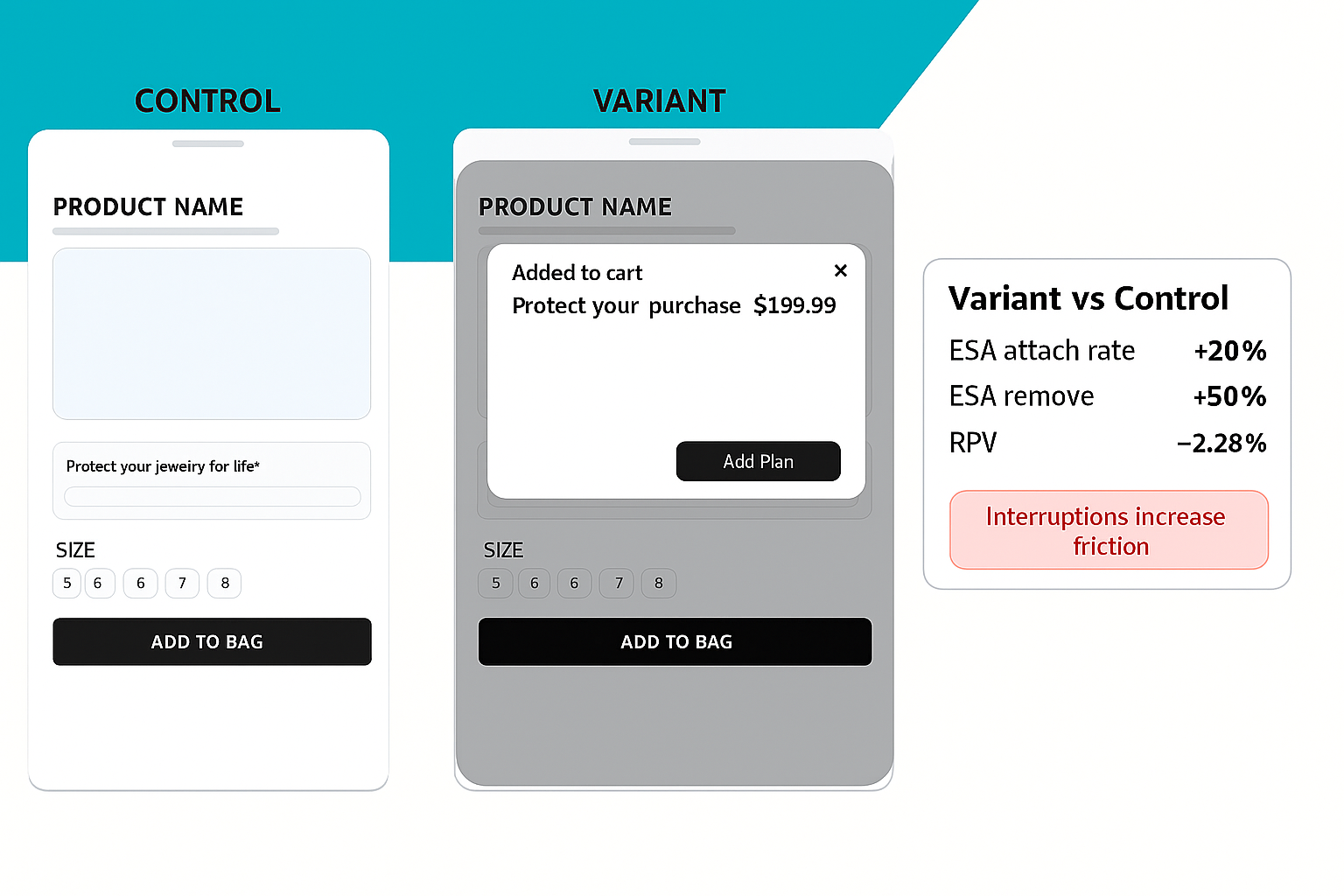
So, a lightbox appeared after Add to Cart whenever a shopper hadn’t yet selected a plan.
The bet
The team believed that making the protection plan decision unavoidable — through a modal prompt — would lift attachment.
- Audience: PDP visitors on mobile and desktop
- Split: 80% control / 20% variant (High Risk Experiment)
- Variant: After “Add to Cart,” show a lightbox prompting a Yes/No decision for the protection plan
- Primary KPIs: ESA Orders, ESA Cart Rate, AOV, RPV
Visitor behavior and revenue were the primary KPIs.
What happened
The attachment rates increased, but the trade-offs told the real story.
- ESA Carts: ↑ ~60%
- ESA Removal Rate: ↑ 50.4%
- Error Rate: ↑ 33.47%
- Revenue per Visitor: ↓ 2.28%
Behavior suggests many shoppers clicked through just to move forward—not because they were committed to the plan. The friction showed up in error spikes, removals, and softer KPIs.
What Missed
The Add-to-Cart moment represents momentum.
Inserting a modal right then interrupts the natural flow from intent to completion.
Instead of progressing toward checkout, visitors were asked to make an unrelated decision — turning focus from buying to closing a pop-up.
In our findings, the post-cart pop-up experiment reinforced that forced modals often hurt user momentum.
Research shows that increasing the visual intensity of overlays without regard for the user’s flow can reduce conversion more than boost it.
Design Choices That Mattered
- The lightbox triggered after Add to Cart breaking flow at the most fragile moment
- The forced choice drove compliance, not confidence
- The pop-up framed the plan as an obstacle rather than a benefit
Guardrails
- Never interrupt the buying micro-flow with a modal
- Keep ESA education inline, near price where it helps, not hinders
- Let shoppers stay in control and move forward on their own terms
Takeaway
You can raise ESA visibility and still lose the sale.
Protect momentum — not just the micro-metric.
Explore more results
- See how our Ways to Pay Card Case Studyachieved an +8.3% RPV lift by prioritizing payment-option clarity.
- Check out our PLA Landing Page Case Study: Turning “Near Miss” Visits into High-Value Orders to see how a PDP pivot module doubled RPV for pivot-users.
- Also read our Promo Drawer Case Study where hiding the site-wide banner and using an on-demand drawer improved RPV while reducing promo clicks.
Want to see all case studies? Visit our full case study library