Intent-driven promotions don’t treat discounts as the focus they align every offer with the visitor’s purpose on site.
Promotions aren’t the issue. They aren’t going away. And they’re not “bad” for your business.
The real issue is how promotions show up.
Most DTC brands lead with promotions instead of supporting the visitor’s intent.
That’s the mistake — and it’s costing real revenue.
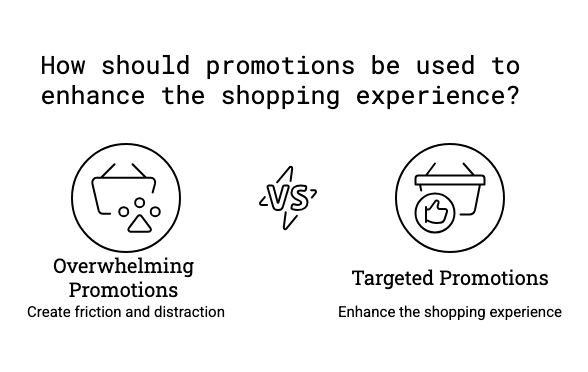
When promotions become the centerpiece of the shopping experience (top banners, sticky ribbons, homepage takeovers, urgent messaging everywhere), they create friction, distract high-intent shoppers, and pull people into weaker categories that don’t match what they came for.
Promotions don’t fail because they exist.
They fail because they’re mis-timed, misaligned, and overexposed.

The Real Problem: Promotions Try to Lead the Journey
Think about what most promo-heavy sites do:
- Big top-of-site banner
- Bold discount messaging on every page
- Multiple overlapping promo messages
- Pop-ups within 3 seconds
- Promotions paired with product discovery (wrong place)
- Links that funnel shoppers into clearance or sale categories even when they didn’t intend to shop there
This creates a forced journey:
“We want you in the sale section.”
But visitors don’t shop the way brands want them to.
They shop based on what they came to do.
And when the promo interrupts that purpose, performance drops.
The Hidden Cost of Leading With Promotions
Here’s what promotions accidentally do when they’re overused:
They pull high-intent buyers off their path
Someone looking for a 10th-anniversary gift gets yanked into clearance.
They see nothing relevant.
They abandon.
According to SmartBug Media, over-discounting can cheapen a brand and condition customers to wait for the next sale. This kind of noise dilutes value messaging and erodes trust.
They compress AOV
Promos steer shoppers into cheaper categories, even when they came in prepared to spend more.
They signal “everything is negotiable”
Once promos feel ever-present, shoppers start waiting for the next one.
They erode product confidence
When everything is wrapped in discount messaging, buyers wonder what’s actually worth paying full price for.
They misidentify who actually responds to deals
Your promo-engaged audience is smaller than you think.
The majority of visitors don’t need a deal to convert.
This is why promo-heavy sites often see lower RPV even when conversion looks “fine.”
When Intent-Driven Promotions Support the Shopper Journey
The fix is simple and has nothing to do with removing promotions.
It’s about changing how they appear so that promotions fit the visitor’s purpose instead of overshadowing it.
These are the four principles behind intent-driven promotions:
- Promotions should appear when visitors show discount-oriented behavior
Examples:- Viewing multiple clearance items
- Filtering by price
- Coming from affiliate/coupon sites
- Returning during known promo windows
- Past purchase history of deals (in known audiences)
- Promotions should not interrupt visitors with a clear mission
Shoppers buying a gift, upgrading, or comparing SKUs don’t need a discount to move forward.
They need clarity and confidence — not distraction. - Promotions should sit under product discovery, not above it
Let shoppers find what fits their intent first.
Then let promotions help them validate the decision. - Promotions should adapt to the context of the page
- PDP?
Show value messaging or shipping/returns first, not promos. - PLP?
Don’t blast promos while shoppers are narrowing choices. - Cart?
This is where promo messaging (if applicable) belongs.
- PDP?
Promotions shouldn’t guide shoppers to the product.
They should support the decision after the shopper finds the right product.
The Promotion Layer That Actually Works
Think of promotions as a support layer, not a navigation layer.
Promotions should:
- ✔ reinforce confidence
- ✔ help hesitant shoppers move forward
- ✔ be relevant to the visitor’s intent
- ✔ provide value without pulling people off track
- ✔ show up when behavior earns it
Promotions should not:
- ✘ override product discovery
- ✘ act as the main CTA
- ✘ be the loudest message on every page
- ✘ pull high-intent traffic into low-value categories
- ✘ create noise where clarity is needed
When you embrace intent-driven promotions as a support layer — not the navigation layer — you’ll see higher AOV and better revenue consistency.
The Bottom Line
Promotions aren’t the enemy.
But plastering them everywhere absolutely is.
Your visitors don’t need more discount messaging.
They need the right message at the right moment for the right intent.
Promotions should support the shopper on their journey — not try to steer the journey.
The DTC brands that get this right will see higher RPV, higher AOV, and far more consistent performance.
Further Reading
If you want to go deeper into improving the shopping journey and reducing friction, here are related guides:
Intent‑Based Personalization: What Scales Better Than 1:1
Personalization Strategy Based on User Intent (Not Demographics)
5 Personalization Mistakes to Avoid (and What to Do Instead)