For years, vendors have positioned 1:1 personalization as the endgame. The “segment of one.” The idea that every visitor gets a perfectly tailored experience built just for them.
It sounds great in a pitch deck.
It rarely survives real ecommerce conditions.
The Problem With 1:1 Personalization
The problem isn’t the concept. It’s the reality of trying to make it work in environments where traffic is mostly anonymous, content production is limited, and teams are already stretched thin. Most ecommerce programs never reach anything close to true 1:1 scale, and even when they try, the results usually fall short of expectations.
This article breaks down why 1:1 is overrated, why intent-based personalization produces bigger lifts with far less effort, and how brands can shift from chasing identity to driving outcomes.

The Visibility Problem: You Don’t Know Most Visitors
Most sites only identify a small fraction of their traffic. Depending on the vertical and login behavior, the identifiable range usually lands somewhere between 2 and 10 percent.
Everything else is anonymous.
This alone makes 1:1 a questionable investment. If only a tiny slice of your audience can receive a truly individualized experience, you are creating disproportionate effort for minimal reach.
Modern privacy changes make this even harder. Browsers block tracking by default. Cookie consent opt-outs continue to rise. Identity stitching across devices and sessions is more fragile than ever.
The result:
Most teams spend their effort building for a small group while ignoring the larger group that could produce bigger gains with less work.
The Content Problem: 1:1 Requires a Content Engine Most Brands Don’t Have
True 1:1 personalization demands:
- unique copy variations
- design variants
- creative assets
- offer logic
- contextual rules
- QA across devices and pages
And all of it needs to be kept fresh, accurate, and aligned with the experience.
Most teams struggle to produce content for one high quality personalization, let alone dozens or hundreds of individualized variants. That type of volume requires an entirely different operational model.
Even enterprise teams often admit their content factory can’t keep up.
The Execution Problem: 1:1 Breaks Under Real Traffic
Many “personalization at scale” promises collapse when real-world complexity kicks in. This can show up as:
- mismatched content
- contradictory experiences
- campaigns firing in the wrong order
- personalization silos across channels
The more complex the targeting, the more brittle the system becomes.
And that’s before the experimentation layer even begins.
The Measurement Problem: Every Personalization Still Needs an A/B Test
This part is often glossed over.
Every 1:1 experience needs A/B testing to validate incremental lift. Without proper testing:
- teams confuse activity with impact
- “wins” become assumptions
- personalization becomes invisible performance debt
- leadership loses trust in program results
Testing dozens of micro-personalizations quickly becomes expensive and unsustainable. Teams either skip testing entirely or rely on shaky heuristics.
If it cannot be measured, it cannot be trusted. And most 1:1 setups cannot be measured cleanly.
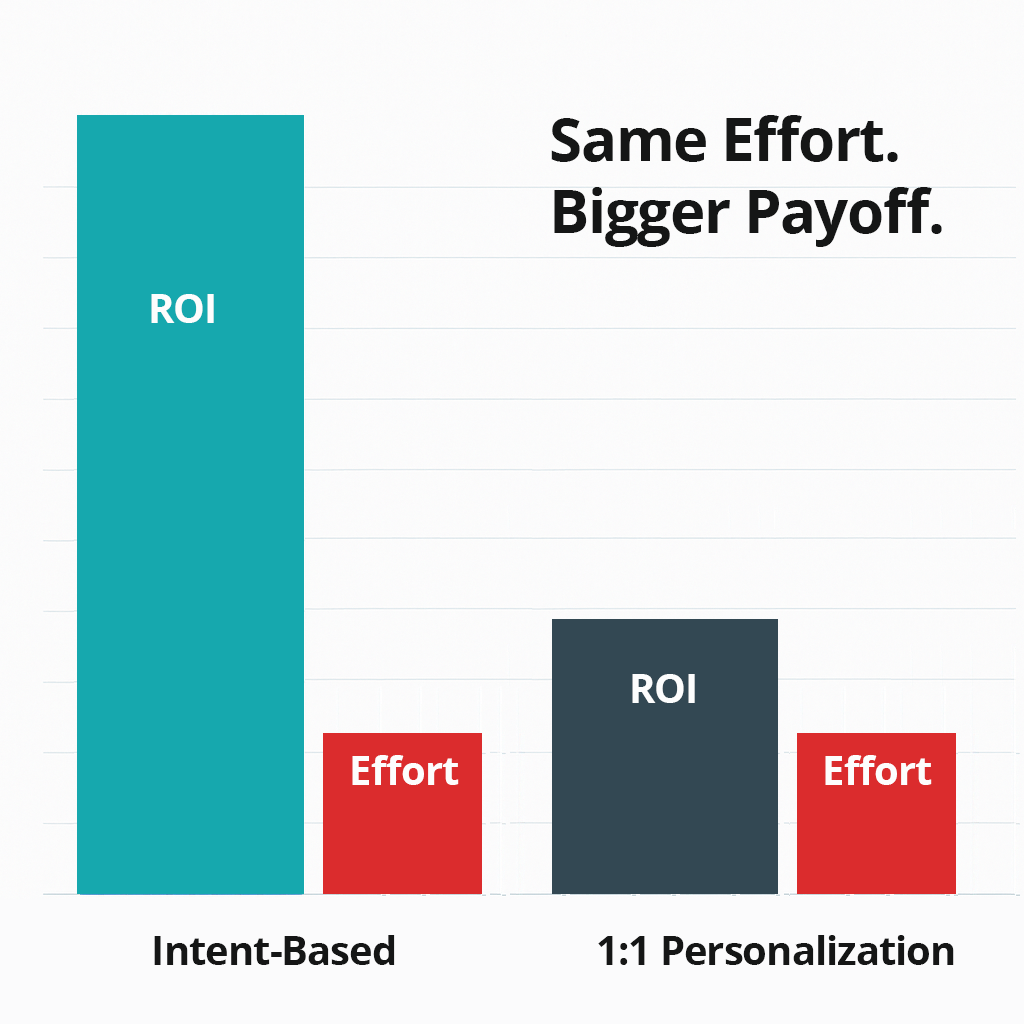
Intent-Based Personalization: Same Effort, Much Higher ROI
Here’s the shift that actually scales:
Move from identity-driven personalization to intent-driven personalization.
Intent-based personalization uses signals you always have:
- the page a visitor entered on
- their click path
- the products they viewed
- search terms
- PDP vs PLP behavior
- cart activity
- category interest
- dwell patterns
- bounce and abandonment tendencies
- traffic source behavior patterns
None of this requires identity.
None of this relies on login coverage.
All of this applies to 100 percent of visitors.
With intent you get:
- faster execution
- simpler content requirements
- wider reach
- higher consistency
- better scalability
- clearer A/B testing
- stronger ROI
You also avoid the operational burden of building 1:1 experiences that almost no one ever sees.
Why Intent-Based Personalization Scales: It Focuses on What Visitors Are Trying to Do
The most powerful personalization doesn’t depend on who someone is.
It depends on what they’re trying to do right now.
Examples:
- Low-intent visitors need reassurance and guidance.
- Medium-intent visitors need friction removed and options narrowed.
- High-intent visitors need clarity, speed, and stronger signals to finish.
- Exit-intent visitors need recovery paths, not identity-based offers.
- Gift shoppers need quick routing.
- Discount shoppers need value clarity.
These patterns apply to everyone, logged in or not.
This is why intent-based personalization produces bigger lifts with less effort. You are meeting visitors at their current task, not guessing at their identity.
The ROI Difference: Bigger Payoff Without Scaling Effort
This is the part most teams feel immediately.
Intent-based personalization:
- reaches the entire audience
- uses data you already have
- requires fewer variants
- avoids identity dependencies
- integrates cleanly into testing
- lifts revenue faster
- reduces operational drag
Identity-based personalization:
- reaches a tiny audience
- depends on volatile data
- requires heavy content
- introduces system fragility
- is expensive to test
- rarely produces outsized returns
Same effort. Bigger payoff.
A Simple Framework to Shift from Identity to Intent
- Define 3–4 key intent tiers For example: low, medium, high, exit-risk.
- Map one personalization opportunity per tier Start with the PDP and PLP. These pages unlock the fastest wins.
- Test everything Use A/B experiments to validate incremental lift.
- Operationalize the winners Turn winning experiments into always-on personalizations.
- Maintain a rotating holdout Keep truth-checking long-term impact on revenue.
This is a scalable personalization engine. It works for anonymous traffic. It works for wide audiences. It compounds over time.
Final Thought: The Real Opportunity Isn’t Identity — It’s Intent
Identity has value, especially for loyalty and lifecycle work.
But in ecommerce, where the majority of site traffic is anonymous and immediate action matters, intent drives the outcomes.
When teams stop trying to build bespoke experiences for a handful of known users and instead design for what visitors are trying to accomplish, everything gets better:
- better UX
- faster pathing
- cleaner experimentation
- clearer ROI
- more revenue
That’s personalization that scales.
And it’s where the biggest lifts live.
This isn’t limited to the website either.
The same intent signals that improve on-site experiences can influence other channels:
- Email sequences triggered by what someone is trying to do, not just who they are
- SMS nudges aligned to current behavior, not generic list membership
- Paid media that adapts creative and landing experiences to in-session patterns
- Even in-store experiences that reflect real shopping context, not static profiles
Identity helps.
But intent travels, which means the same framework can unify how teams personalize across the entire customer journey.
(And that deserves its own article.)
Further Reading
If you want to go deeper into intent-based personalization and improving the shopping journey, here are related pieces from across the site:
How Intent Wins: A practical framework for identifying visitor intent and using it to guide onsite experiences.
Fixing PDP Friction: How to reduce clutter, remove blockers, and help visitors get to the next step faster.
Zero-Party Intent Signals: A look at the “How Can We Help?” pop-up and why asking one high-signal question can outperform identity-based tactics.
External Resources
Made With Intent: Real-time intent scoring that strengthens onsite relevance.
Dynamic Yield: Approaches to personalization for ecommerce brands.